
Unveiling the Tests Conducted on Vacuum Flasks Before Leaving the Factory: Part Two
There are stories in every cup, and warmth in every life. Hello everyone, "Dong Dong's Cup Talk" is here! Today, we've invited Minister Li Hang from our factory's Quality Inspection Department to talk about the tests that stainless steel vacuum flasks undergo before leaving the factory. https://www.zhanyict.com/en/ProductsDetail-VB-10523.htmlThe following content is based on Minister Li's narration and has been compiled by me. Due to the extensive content, I will share it in multiple parts.
Hello everyone, I'm Li Hang. I've been working in quality inspection at this factory for fifteen years. Over these years, I've led my team in testing millions of cups, from orders for major domestic supermarkets to stringent projects exported to Europe, America, Japan, and South Korea. https://www.zhanyict.com/en/ProductsDetail-VB-10523.htmlAlmost every day, I deal with data related to salt spray, drop tests, and thermal insulation performance. At the same time, I'm also a mother of a six-year-old boy. Every day, when I prepare warm water for my child to take to kindergarten, what concerns me most, just like you, is whether the cup is truly safe, durable, and healthy.
Today, I want to take you behind the scenes of the "graduation ceremony" that every vacuum flask must undergo before leaving the factory, https://www.zhanyict.com/en/ProductsDetail-VB-10523.htmlsharing my insights both as a professional and as a mom.
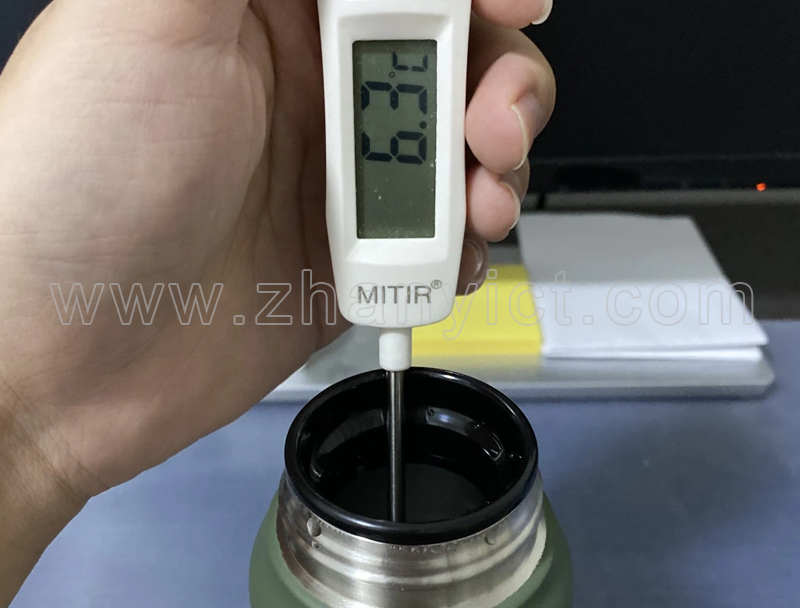
2. Thermal Insulation Performance Test – Assessing the Cup's "Core Competency"
Thermal insulation performance is the soul of a vacuum flask. https://www.zhanyict.com/en/ProductsDetail-VB-10523.htmlOur testing process is far more precise than the homemade method of "leaving hot water overnight."
Testing Standards:
In an environment with a room temperature of 20°C ± 2°C, we fill the flask with hot water at 95°C or above and screw the lid on tightly. After 6 hours, the water temperature must not fall below 68°C; after 24 hours, it must not fall below 40°C. https://www.zhanyict.com/en/ProductsDetail-VB-10523.htmlOnly those that meet these criteria are considered excellent.
Practical Case:
- Export Orders to Europe: The EU's EN 12546 standard has extremely strict regulations for the testing environment, water temperature, and duration for thermal insulation tests. https://www.zhanyict.com/en/ProductsDetail-VB-10523.htmlWe must conduct the tests in a laboratory environment approved by the EU and provide detailed reports. Compared to routine domestic tests, the control over environmental temperature and humidity is much more precise.
Differences Between Testing Agencies:
This leads to a common question: Do different agencies follow the same standards when testing thermal insulation? https://www.zhanyict.com/en/ProductsDetail-VB-10523.htmlThe answer is: While the core principles of the standards are the same, specific parameters and recognition levels may vary.
For example, there are slight differences between China's national standard (GB/T) and the EU's EN standard in terms of testing duration and allowable temperature variations.
- When testing is done at the China Quality Inspection Center, it primarily follows the national standard and issues a CNAS (China National Accreditation Service) report.
- When conducted by SGS, https://www.zhanyict.com/en/ProductsDetail-VB-10523.htmltesting is performed according to the client's specified standards (such as the EN standard), and an internationally recognized report is issued.
For export products, target markets place greater trust in certificates issued by agencies like SGS and ITS based on their local standards.
There are stories in the cup, and life has warmth. Choose a good factory to sell good water cups. We provide global OEM services for patented products and provide global OEM services with professional teams and high quality standards. Dongguan Zhan Yi Commodity Technology Co.,Ltd. specializes in high-quality cup and kettle products. We are willing to serve you wholeheartedly.